Chronic Pain, Neuroscience, and the Degree I Didn’t Plan to Take
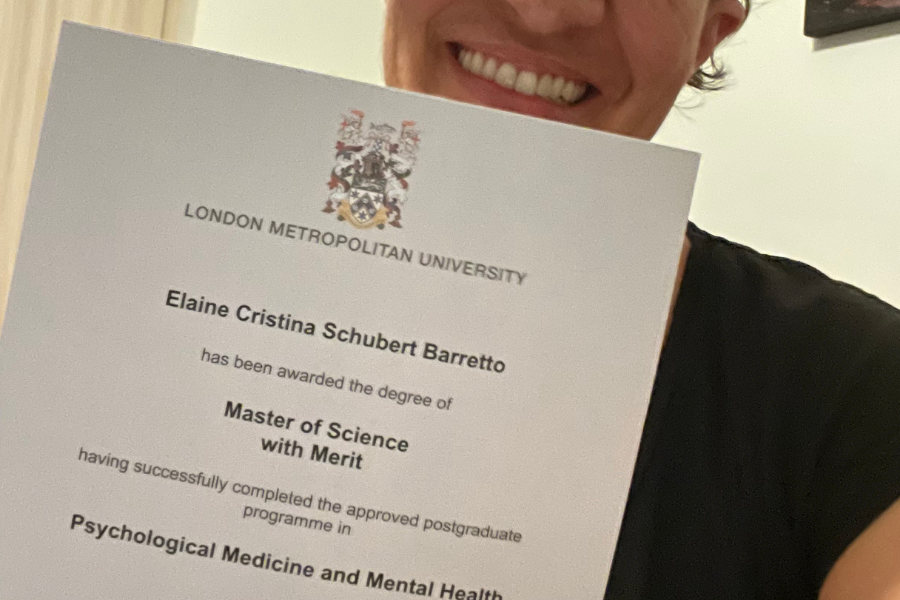
I didn’t intend to leave science.
In fact, when we moved to Singapore, I eventually found my way back into it. I worked in machine learning, AI, semiconductor research, and grant management for the government. It was stable. Interesting. Technically stimulating.
And yet, something had shifted.
I was finishing my health coaching training on the side when COVID arrived. At the same time, my father became critically ill in Brazil. He underwent two brain surgeries after a hemorrhage whose cause wasn’t entirely clear.
Travel during COVID was complicated. Emotional. Uncertain.
I flew back and forth to support my family, trying to be present not only as a daughter, but almost as a patient advocate — helping interpret symptoms, reading papers on brain health, asking questions in medical appointments.
After everything I had learned about neuroscience, lifestyle, and systemic health, I could not unsee the connections.
My father had suffered a heart attack in his 40s. I knew his lifestyle history. I knew the risk factors. I knew how interconnected vascular health, stress, inflammation, and behavior truly are.
And once you start seeing healthcare through that lens, it becomes impossible to look away.
Leaving a Secure Career
When I returned to Singapore, I made a decision that surprised even me.
I left my government research position.
It was secure. I liked my colleagues. The work was intellectually engaging.
But my mental space was no longer there.
My mind was occupied — constantly — with behavior change, chronic illness, nervous system regulation, prevention, psychology.
I opened my own health coaching practice.
I built a calm, beautiful space. I worked mostly with women navigating stress, chronic symptoms, motherhood, identity shifts. Many were expats. Many were exhausted in ways that did not show up in blood tests.
I recognized myself in them.
And yet, despite everything I had learned — mindfulness, nutrition, coaching, nervous system work — there was one symptom I still couldn’t fully resolve.
My pain.
The Pain That Wouldn’t Leave
I had lived with shoulder pain since my teenage years.
It was severe enough to make me quit competitive swimming at 14. I had been through doctors in Brazil, Denmark, Germany, Switzerland, Singapore.
I had imaging results. Structural findings. Terms like “impingement” and “subacromial type II.”
None of them explained the intensity.
None of them explained why my pain worsened dramatically around my menstrual cycle.
By this point, I was running half marathons. My blood markers were excellent. My sleep had improved. My stress was managed.
But the pain remained.
And that discrepancy fascinated me.
Discovering Nociplastic Pain
When I began reading deeply about chronic pain neuroscience, something clicked.
There was a landmark paper in The Lancet discussing chronic pain as a condition in its own right — not merely a symptom — and introducing clearer categories, including nociplastic pain.
Pain that is real.
Pain that is disabling.
Pain that does not always correlate with tissue damage.
Pain shaped by nervous system sensitization.
This was the framework I had been searching for.
Not psychosomatic.
Not structural.
Not imagined.
But neurobiological — shaped by complex interactions between stress, hormones, immune signaling, past experiences, and the brain’s threat perception systems.
The Master’s I Didn’t Plan
At that point, curiosity became commitment.
I enrolled in a Master of Science in Psychological Medicine and Mental Health.
I chose to write my dissertation on psychological therapies for nociplastic pain.
Not only because it was academically interesting.
But because it was personal.
I wanted to understand:
How psychological interventions affect pain pathways.
How neuroplasticity reshapes symptom perception.
What role the nervous system plays in chronic pain syndromes.
What works beyond medication.
I trained further in pain neuroscience education. I studied mindfulness for chronic pain through the University of Toronto. I explored emerging therapies aimed at retraining the brain.
And slowly, applying these approaches with the help of skilled professionals, my relationship with pain began to change.
Not overnight.
Not magically.
But meaningfully.
From Chronic Pain to Women’s Health
That research also led me into another field: pelvic pain, endometriosis, and women’s health.
I began to see patterns — how chronic pain, hormonal shifts, trauma, stress, and inflammation intersect.
Again, interconnected systems.
Again, no single-discipline answer.
Closing the Loop
After completing my Master’s, I sat for the board examination in Lifestyle Medicine — this time not only as a coach, but as a formally trained professional in the health sciences.
The engineering background.
The coaching training.
The psychological medicine degree.
The lived experience.
The neuroscience.
The lifestyle science.
They finally began to converge.
And what started as a search for answers to my own pain became the foundation of my professional identity.